To winterize an outdoor faucet in Pierce County, take the hose off, close the indoor shutoff that feeds the faucet if there is one, and open the faucet outside so the line drains. Cover any spigot that is not frost-free. Do it before the first hard freeze, because a split hose bib often leaks inside the wall unseen.
Outdoor Faucet Questions, Answered
Do I need to take the hose off a frost-free outdoor faucet?
Yes. A frost-free faucet only works if the water left in its long body can drain out when you close it, and a hose left attached traps that water. When it freezes, the barrel can split inside the wall, and you will not see the leak until you turn the faucet on in spring and water runs into the house.
How can I tell if my outdoor faucet is frost-free?
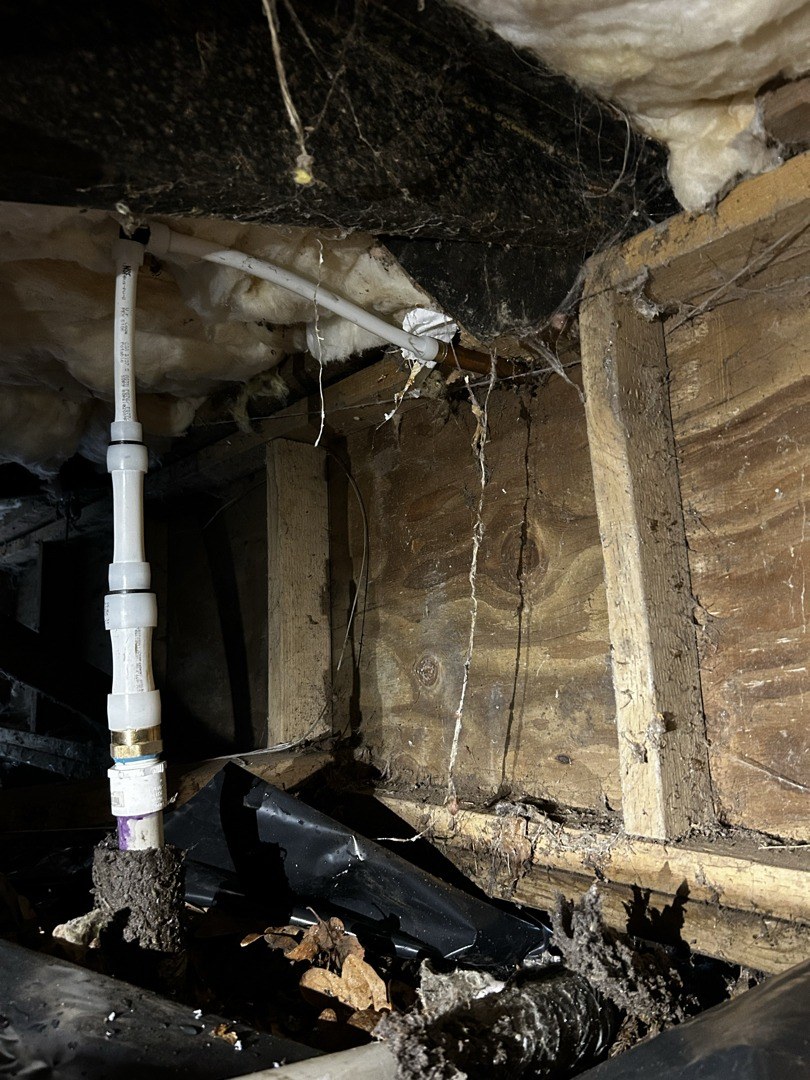
Look at where the pipe meets the faucet from inside, in the crawl space or basement. A frost-free faucet has a long body, often several inches or more, that reaches through the wall to a valve inside. A standard hose bib is short and closes right at the outside face, where it is exposed to the cold.
Is a foam faucet cover enough to stop a freeze?
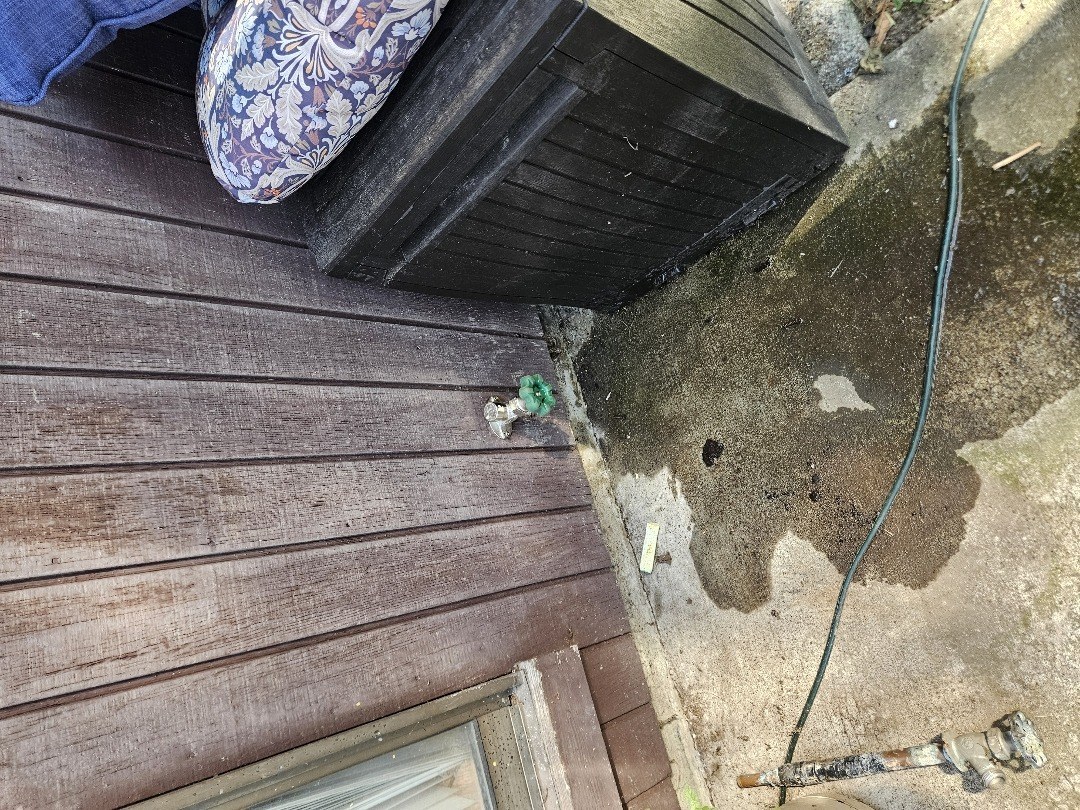
It helps on a standard hose bib, but it is not a guarantee. A cover holds some of the house’s warmth around the spigot on a frosty night. In a long cold snap, a faucet fed through a cold crawl space or an outside wall can still freeze behind it, so closing the shutoff and draining the line matter more.
What happens when an outdoor faucet freezes and bursts?
The pipe splits where the water froze, often inside a wall or ceiling, and leaks the next time the faucet is used. In Edgewood in October 2025, a rear hose bib fed by copper through a lower-level bathroom ceiling had burst there. Devin replaced it with a frost-free hose bib, joined new PEX to the copper and insulated it.
Why does my outdoor faucet spray from the top when the hose is running?
The vacuum breaker has failed. It is the small cap on top of most outdoor faucets that lets air in so hose water cannot be drawn back into the house, and when its seal wears, it sprays. In Tacoma’s West End this September, James replaced the leaking vacuum breaker on a back-deck hose bib and it stopped leaking.
Should I replace an old hose bib before winter or wait until it fails?
Replace it before winter if it drips, if the handle is stiff, or if it is a standard spigot on a line that has frozen before. A worn faucet is a small repair on a dry day and a wet wall after a freeze, and fall is when we can schedule it without the rush that a cold snap brings.
What does the plumbing code expect from a new outdoor faucet?
Inspection checklists that Washington building departments use under the state’s plumbing code call for an exterior hose bib to be frost-proof, to carry a built-in vacuum breaker that drains itself, and to be caulked and secured to the outside wall. That is how we install every new one, whether or not the existing faucet met that standard.
Our Recommendation
Spend ten minutes on every outdoor faucet this fall: hoses off, indoor shutoffs closed, standard spigots drained and covered. Then make a list of the ones that have frozen before, drip, or sit on a line that runs through a cold crawl space, and replace those with frost-free hose bibs while the weather is still dry. A frost-free faucet with the hose taken off is the setup that keeps a cold snap from becoming a ceiling repair.
Getting Your Outdoor Faucets Ready
Whether it is one dripping spigot or every hose bib on the house, call us or request service, and we will tell you what each one needs and what it costs before any work starts.
More: faucet and hose bib repair in Tacoma · faucet repair and installation · two frost-free hose bibs replaced from a Tacoma crawl space · faucet repair in Spanaway · pipe repair in Tacoma